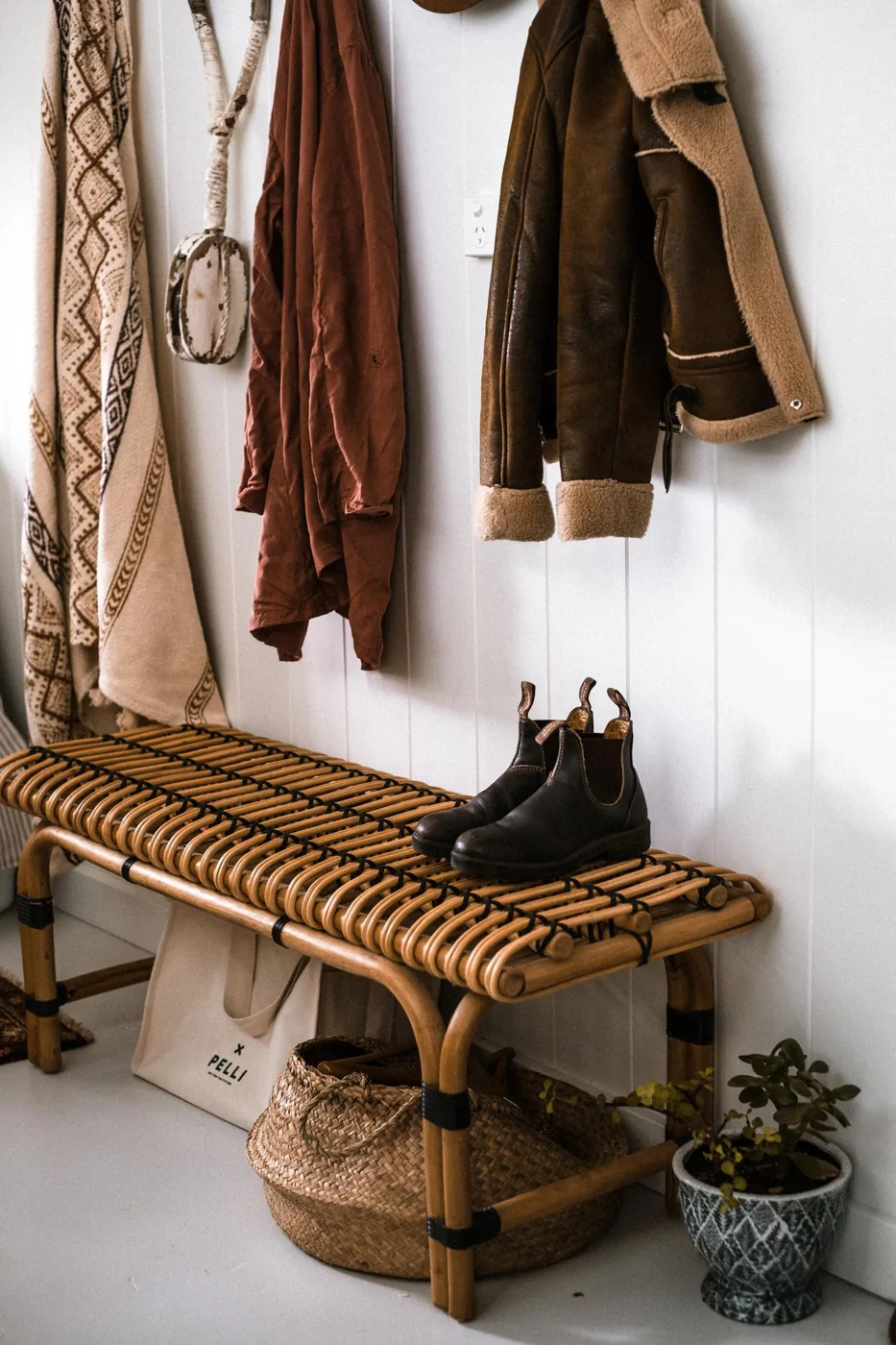
A rail with many hooks may hold fewer comfortable coats than its product photograph suggests. The useful space includes garment width, hanging height, bag straps, and the route through the room. Before adding another rail, assess how the household's actual coats use the hooks already available.
Identify the everyday garments
Gather the coats normally arriving at the same time, without overloading the current fixture. Notice their length, bulk, and hanging loops. A thin summer jacket and a substantial winter coat can occupy very different space.
Separate occasional outerwear from the everyday entry requirement. The hallway does not need to hold every coat in the household if suitable storage exists elsewhere. Choose a realistic current set rather than planning a display for the whole wardrobe.
Measure the full hanging area
Check the fixture's dimensions and the space beneath and beside it. Include door movement and the route past hanging garments. A hook can be technically reachable while the coat on it blocks another essential use.
Follow installation and load guidance for the exact fixture and wall or support. Obtain competent help where appropriate. Do not add hooks to an unsuitable surface or infer load capacity from their appearance.
Compare hook spacing with real overlap
Try the intended garments appropriately on a suitable existing arrangement. Notice whether one coat covers the next hook or whether bag straps become entangled. More closely spaced hooks can increase the listed count without improving usable capacity.
Consider the people using the rail and their reach requirements. A lower suitable position may help one household member but needs assessment of what will hang below it. The entire arrangement should work for the people, not only the longest garment.
Give damp outerwear a separate plan
Read garment care instructions and arrange suitable handling for wet coats. Do not force damp fabric into a tightly crowded group because the rail has a spare hook. Care needs and room conditions may call for a different temporary route.
Keep accessories with clear appropriate homes. An entry rail becomes harder to use when umbrellas, scarves, bags, and unrelated objects fill every gap. Define the contents rather than buying another row automatically.
Buy for the measured problem
If a new fixture is needed, compare actual spacing, intended load, installation, material care, and usable height. Include appropriate fixing and any professional installation in the budget. A modest well-suited rail can be more valuable than the highest hook count.
Does more hooks mean more capacity? Check garment overlap and stated limits. Can bags share every hook? Assess the complete load and access. Should all coats stay by the door? Keep the everyday set appropriate to the space.
Our basket guide helps assign accessories a useful place. The guest-room guide considers visitors' belongings beyond the entry.
Where to start browsing
These direct retailer links are a starting point for comparison. Confirm current stock, materials, dimensions, delivery and returns on the retailer's own site. Photographs show lifestyle inspiration, not a specific product being sold.
IKEA serving bowls ↗
Compare serving-bowl shapes, materials and dimensions.
Crate & Barrel cloth napkins ↗
Compare cotton and linen options, sizes and care instructions.